
Bible

2025: The Year Something Changed?

Update: On 9th January, a report came a report came out highlighting how Bible sales have also surged in the UK, with sales up 106% in volume from 2019, including a 28% increase between 2025 and 2025.

2025 has been an interesting year.

In January, the world’s most popular podcast – the Joe Rogan Experience – featured an interview with Christian apologist Wes Huff. In February, Larry Sanger, the co-founder of Wikipedia, announced that he had become a Christian.

In September, the world’s second-most popular podcast, Diary of a CEO, had an episode entitled: ‘Is Not Believing In God Causing More Harm Than Good?!’

As I mentioned in a previous column, the host, Steven Bartlett gives the example of a 35-year-old friend in Dubai. Six months ago, he told his friends that he couldn't get out of bed anymore. Fast forward to today and he’s become a Christian, got baptised and ‘suddenly his life has purpose and meaning again — he's a completely different person’. This is despite, Bartlett says, him being the last person you would ever think would be religious.

Bartlett himself went through what he calls a ‘new atheist baptism’ at the age of 18. ‘But now’, he says ‘I find myself in a position where I'm almost back to being curious again’.

Bartlett echoes what many are feeling. People are detecting a ‘vibe shift’. As he himself puts it: ‘there is something going on’.
One of the metrics that would seem to back this up is Bible sales. A year ago, the Wall Street Journal reported: ‘Sales of Bibles are booming, fuelled by first time buyers’. The article that followed reported on a 22% rise in Bible sales.Then in September of this year, there was a 36% jump compared to the year before.

Another trend this year has been people posting on social media that they’re about to read the Bible for the first time, and asking where they should start.

Most people would recommend starting to read the Bible in one of the gospels – the first four books of the New Testament. And if someone were to start with either Matthew’s or Luke’s account of Jesus’ life, they would begin with what has become known as the Christmas story – the birth of Jesus.

And on this Christmas Eve, I want to highlight two things about the Christmas story.

The first thing is that it didn’t come out of the blue.

In other words, it was expected. Many of the details had been prophesied 700 or more years before. The fact that Jesus would be born of a virgin, even the name of the town in which he’d be born. In the last week or so, the ever-thought provoking Glen Scrivener tracked down and interviewed Steven Bartlett’s friend, who had gone from not being able to get out of bed to becoming a Christian. In the interview, the friend reveals that he’d actually started looking into Christianity to try and disprove it – because he realised that as an atheist, he had rejected it, but he knew nothing about it.
But one of the things that convinced him of Christianity were all the connections between the Old Testament – the first half of the Bible – and Jesus. This is despite the fact that the Old Testament was written hundreds and even thousands of years before Jesus came. The Christmas story happened exactly as God had said it would, which is powerful evidence for the truth of it.

The second thing I want to highlight about the Christmas story is to do with the visits of the angels. Angel appearances aren’t particularly common in the Bible, but they’re all over the Christmas story. An angel appears to John the Baptist’s father, then to Mary, then to Joseph, then to some shepherds in a field watching their flocks by night. Yet almost every time an angel appears, before it can give the message that it’s been sent by God to give, it has to begin by saying ‘Don’t be afraid’. Because people are terrified.

But the news they have for us is good news, and so they start: ‘Do not be afraid’.

It reminds me of the last words of the Irish poet Seamus Heaney. A couple of minutes before he died, Heaney texted two words to his wife: ‘Noli timere’ – Latin for ‘do not be afraid’.

I’m sure that was a great help to her. But how much better it would be to hear those words from beyond the grave. From someone who had died and come back, and was able to tell us ‘Do not be afraid’.

Well in short that’s the Christmas story.

That’s the Bible’s message.

That’s what’s on offer.

And at the end of a year in which many have turned back to God – it’s at least worth investigating.

Published in the Stranraer & Wigtownshire Free Press, 24th December 2025.

It’s World Book Day – have you read the all-time bestseller?

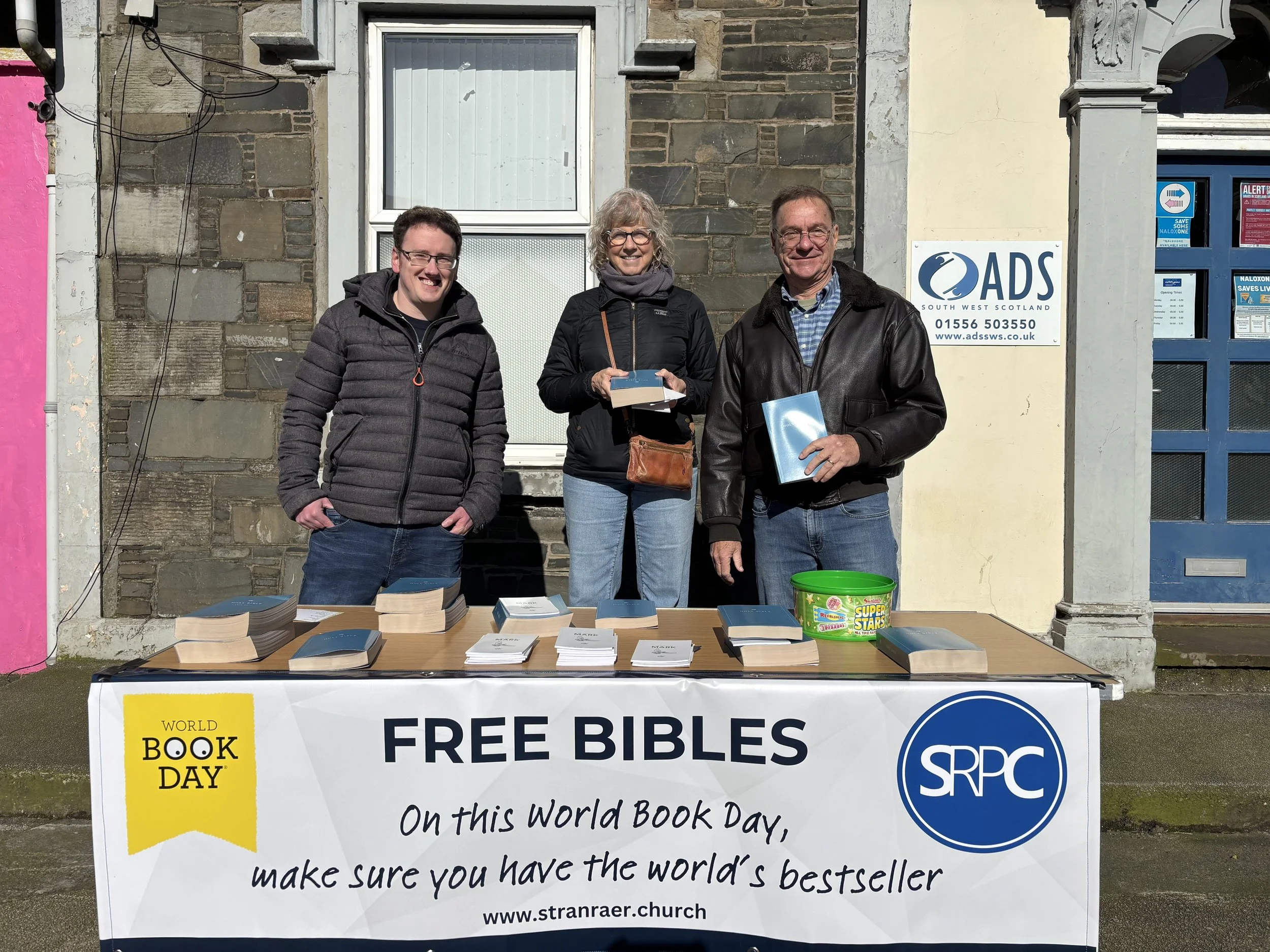
Today is World Book Day. While that might be news to some, it won’t be to anyone who has children in school. Children dress up as characters from books, are given book vouchers, etc. This year, we have decided to mark the day as a church by giving out free Bibles in the town centre. After all, it’s the bestselling book in the history of the world! If you’ve never read the Bible, there’s no better time to do so. If I can’t convince you, perhaps comedian Lee Mack can. Mack was interviewed on Desert Island Discs recently. He was asked which book he would take with him—you’re allowed the Bible, the works of Shakespeare and one other. He chose Stephen Hawking’s ‘A Brief History of Time’, but it was his comments about the Bible that intrigued me.

 He said, ‘I’m glad you get the Bible, because I would read the Bible. I think it’s quite odd that people like myself, in their forties, are quite happy to dismiss the Bible, but I've never read it. I always think that if an alien came down and you were the only person they met, and they said, “What’s life about? What’s earth about? Tell us everything,” and you said, “Well, there’s a book here that purports to tell you everything. Some people believe it to be true; some people do not believe it to be true.” “Wow, what’s it like?” and you go, “I don’t know, I’ve never read it.” It would be an odd thing wouldn't it? So, at the very least, read it’.

Many are happy to accept the opinions of others about the Bible (both positive and negative) without ever reading it themselves. Others feel let down by church, but are reluctant to read the Bible for themselves. Some are struggling with life and trying to get through by their own strength, unaware that the Bible has help to give. Even many churches have in practice abandoned the Bible – and it’s no surprise they’re declining and closing.

Perhaps you’ve tried reading the Bible before, but haven’t really known where to start. It’s easy to get bogged down. One of my recommendations is to begin reading The Gospel According to Mark – the second book of the New Testament. It’s the shortest of the four gospels and gets straight to the action – the life and death of Jesus Christ. We actually have 80 copies of Mark’s gospel to give away today, if picking up a whole Bible seems intimidating. We also have a leaflet entitled ‘What the Bible is all about’, which we’ll put inside everything we give out.

I’m also happy to meet up with anyone, either one-to-one or as part of a group, to read through a book of the Bible and discuss what it’s about. In fact, there’s a story in the book of Acts (which we’re currently going through in church on Sunday mornings – you can catch up on YouTube), where an evangelist called Philip meets a man travelling back home to Ethiopia. The Ethiopian is reading the Bible in his carriage. Philip asks him: ‘Do you understand what you are reading?’ The Ethiopian replies: ‘How can I, unless someone guides me?’ He then invites Philip to come and sit with him, and the rest is history. There’s no shame in asking for help.

When the Bible was translated into the language of the common people, it scandalised many of the church leaders, but transformed this nation. The man who first translated the Bible into English, William Tyndale, was burnt at the stake. It is still a banned book in many countries. Why not read it and find out why its contents are so explosive?

What many people – even churchgoers – can miss about the Bible is that it’s all about Jesus. That’s what Philip showed the Ethiopian, who was struggling as he read a 700-year-old prophecy from the book of Isaiah. ‘Is he speaking about himself or someone else?’, the Ethiopian asked. Philip gladly took the opportunity and ‘beginning with this Scripture he told him the good news about Jesus’ (Acts 8:35). ‘The Scriptures’, Jesus said, ‘bear witness about me’ (John 5:39). The Bible is all about who Jesus is, why he needed to come, and how he can transform our lives.

 There are many good – even life-changing – books you could read on this World Book Day. But why not read the all-time bestseller?

Published in the Stranraer & Wigtownshire Free Press, 6th March 2025

The Toymaker's Tale

The Christmas trees are down, the decorations put away. Some of the long-awaited toys are being played with – others, not so much. But as long as the toymakers got our money, they’ll be happy, right?

 Maybe not. A few years ago, the American journalist David Pogue conducted a fascinating interview with Melissa and Doug Bernstein – known for their billion dollar toy brand, ‘Melissa & Doug’. They specialise in high quality, low-tech toys, and despite the advent of screens and smartphones, had just recorded their 32nd straight year of growth.

On the face of it, Melissa has it all: a loving husband, six high-achieving children and four homes – including a 38,000-square-foot mansion with its own bowling alley, basketball court, and arcade. She says: ‘I can certainly admit that I have enjoyed the material trappings that come from being successful, all those material rewards that make us feel that we’ve “made it”’. 

Yet you may have guessed there’s a ‘but’ coming.

Melissa went on to say: ‘From my earliest recollections, I felt that something was profoundly wrong deep within my being. Why am I here? What is the meaning of life if we are all ultimately going to die? I felt utter despair’.

For most of her life, she hid this ‘existential depression’. Her only therapy was writing what she calls ‘verses’. As a 5-year-old she wrote: ‘I am fearful, oh so fearful, if you do not show me light, I will lose the will to live, and choose to end this futile fight’.

From the age of 11 she would battle with various eating disorders: ‘I controlled everything I could control since I could not control my thoughts’. For close to a year, when at college, she carried a bottle of pills everywhere, carefully researched to be able to stop her heart.

Finally, she sought help. She shares her story in the self-published book ‘Lifelines’, which contains some of the 3,000 ‘verses’ she had written, but never showed to anyone before. An accompanying website offers help to other sufferers. The front of the book proclaims Melissa’s goal: ‘Today I saved a life, although it was my very own, which won’t serve a greater purpose till I rescue lives unknown’.

Melissa’s story is instructive in several ways. As Pogue commented, we may assume that ‘consumption makes you happy, money makes you happy’ – but here’s someone who had it all and was still miserable. Indeed, as a society we have more than previous generations could have dreamed of, but as Melissa says, ‘the next pandemic is depression’.

Yet Melissa’s story is perhaps not as hopeful as it seems on the surface.

The sceptic who visits her website – which Pogue said ‘might end up saving lives’ – is immediately presented with the option to ‘Explore Products’, such as essential oil diffusers. It seems less a lifesaving resource, more just another way to make money.

But even if her motivations are completely philanthropic, those who remember how the story began will notice that Melissa never answered the questions that tortured her from childhood: ‘Why am I here? What is the meaning of life if we are all ultimately going to die?’

Pogue said of ‘Lifelines’ – ‘there may be people who owe their continued existence to this enterprise’. Melissa’s book proclaims her goal to ‘rescue lives unknown’. But what neither of them address is why that’s important. Why are lives worth saving, if we’re all ultimately going to die?

This is a time of year when many are despairing. It’s hard not to notice the frequent news reports of young, healthy people dying suddenly, with no cause of death given.

What can give them – and all of us – hope? I would suggest the answer is indeed found in verses – not the 3,000 written by Melissa, but the 31,102 in the Bible. The verse numbers themselves are not part of the original text, but added much later. In fact, they can sometimes mask the fact that the Bible is a story – which is why, in recent years, some Bible publishers have begun printing ‘Reader’s Editions’ without them.

The Bible’s story answers the questions that have tortured Melissa and others for so long: Why am I here? Why do we have the sense that something has gone profoundly wrong? Is there any hope?

Melissa’s story may save some from thinking that ‘stuff’ will satisfy. But finding true hope requires finding our place in a deeper, truer, story. It can give what her book can only promise: ‘an inspirational journey from profound darkness to radiant light’.

Published in the Stranraer & Wigtownshire Free Press, 9th January 2025

Good News For Everyone: Wigtown Event

At the end of September, Good News For Everyone (formerly Gideons UK) held an event in Wigtown Baptist Church, to tie in with the Wigtown Book Festival. There were various updates on the work of the organisation, and also interviews with Stephen, as well as Daniel Sturgeon (pastor of Stranraer Baptist Church). The Wigtownshire Branch is currently looking for new members as they seek to continue their good work of giving out Bibles in schools, placing them in hotels, and producing other helpful resources.