Church

What's Missing from Ch--rch?

Every so often I'll see a sign or a facebook post asking "What's missing from ch--ch?" The answer? "U R" (you are). It's a mildly humorous attempt to encourage people to come back to church, or to start attending for the first time.

And yet there is something more than people missing from many churches in Scotland. What's often missing today is what the Reformers described as the "marks" of the church. Men like John Knox identified three marks of the church: the preaching of the gospel, the pure administration of the sacraments, and the exercise of church discipline. In other words, a church is not just an organisation that calls itself a church, it must have the marks of the church. Certainly, there are other attributes of healthy churches, but these three were singled out because they are visible as well as foundational. A church missing these marks may still meet, it may still organise lots of activities — but it may not be a true church. It may once have been a true church. It might not have been turned into a restaurant or flats or a carpet showroom. People may still meet there on Sundays, sing hymns, and listen to someone speak from the front — but it may no longer Biblically qualify as a church.

These three marks weren't just randomly plucked from the air: they were drawn from Biblical passages such as Acts 2:42 where we're told that the first Christians "devoted themselves to the apostles’ teaching and the fellowship, to the breaking of bread and the prayers".

The Reformers agreed that the foundational mark of the church was the right preaching of the gospel. Just because someone speaks from a pulpit does not mean they are preaching the gospel. The Bible is often used to give moral lessons — along the lines of Aesop's fables. But men, women, boys and girls are not confronted with their need, as Jesus himself put it, to be "born again" — "to repent and believe in the gospel". One place where the lack of true gospel preaching is often seen is at funerals. The Christian hope in the face of death is wrongly applied to those whose lives demonstrated that they had no interest in Jesus Christ. Those present are left with the impression that everyone will get to heaven in the end. It might not have been said in so many words, but the heresy of universalism has been proclaimed. An opportunity to graciously and lovingly preach the gospel to (perhaps) hundreds of people is missed.

The Reformers identified the second mark of the church as the right administration of the sacraments. They began by identifying two (and only two) sacraments — baptism and the Lord's Supper. But these sacraments had to be rightly administered: baptism is not to be given to everyone who asks for it — it is only for believers and their children. Likewise, the elders of the church are to exercise oversight as to who comes to the Lord's Table. Yes, a person is to examine themselves (1 Cor. 11:28), but the elders also have the responsibility to "purge the evil person from among you" (1 Cor. 5:12).

This brings us to the third mark of the church: the exercise of church discipline. It has been said: “When discipline leaves a church, Christ goes with it". "Discipline" can sound scary, but we tend to recognise that it's not a good thing for children to be brought up without it. In the church it's simply part of pastoral care — the recognition that every sheep needs a shepherd. A shepherd who cares for you so much that if you go astray, they'll come after you, rather than leaving you to wander. Or if you get hurt by someone, they'll come alongside you.

For this mark to be present, the church needs elders who meet the biblical qualifications set down in 1 Timothy 3 and Titus 1. Tragically, however, eldership in many Scottish churches has become a way of honouring people who've been around for a while — or been given to those who are respected in the community — irrespective of whether they have faith in Jesus. Someone once told me that their elders had never talked to them about the Bible. When it gets to the point that most of the elders shouldn't even be church members, it's clear that this mark was lost long ago.

So what's missing from church? Often the reason that people have deserted a congregation is due to the missing marks. For example, if people don't hear anything different on a Sunday than they could hear on the news or from a self-help book, why go? If public sin goes unchallenged, why invest your energies? The lack of these three marks has very practical consequences. The Reformers weren't motivated to talk about “true” and “false” churches by ego or arrogance, but by a sincere desire for the spiritual health of God's people and their communities — and his glory.

Certainly, there can be true Christians in churches where these marks are missing. But God himself would say to them, "Come out of her, my people" (Rev. 18:4).

Published in the Stranraer & Wigtownshire Free Press, 9th July 2026

NOTE: James Bannerman identifies a progression from “the somewhat loose and popular definitions of the Church visible, commonly given at the Reformation, to the stricter and more scientific definitions of the seventeenth century”. He makes a distinction between things which are necessary for the church’s existence, and its well being. It is, he argues: “apostolic doctrine which alone marks out a Church of Christ".

A new generation are asking the most important questions

This Easter will be particularly joyous for Christians in Scotland with churches having only just returned to worship after a further three months of lockdown restrictions. And yet it won’t be a case of ‘as you were’ before coronavirus hit.

While many will be ecstatic to be back, some will be apprehensive – and others may not come back at all. A leaked Church of England report suggested that a fifth of worshippers may not return post-Covid. North of the border, there will be similar concerns.

Others however will be watching on optimistically to see if the undoubted rise in spiritual interest there’s been during the pandemic will translate into people returning to church after decades – or starting to come for the first time. 

In a recent New York Times opinion piece, the writer Leigh Stein spoke for many millennials when she admitted: ‘I have hardly prayed to God since I was a teenager, but the pandemic has cracked open inside me a profound yearning for reverence, humility and awe’.

Screenshot 2021-04-01 at 16.13.10.png

In her article, entitled ‘The Empty Religions of Instagram’, Stein argues that while 22% of millennials (those like myself born between 1980 and 1995) would describe themselves as having no religion, they have simply swapped traditional religion for new moral authorities – namely, social media influencers. Televangelists like Billy Graham have been swapped for Instavangelists like Glennon Doyle and Gwyneth Paltrow, but ‘we’re still drawn to spiritual counsel’, such as ‘It’s ok not to be ok’.

However, writing as a ‘leading feminist’ (Washington Post), she says ‘the women we’ve chosen as our moral leaders aren’t challenging us to ask the fundamental questions that leaders of faith have been wrestling with for thousands of years: Why are we here? Why do we suffer? What should we believe in beyond the limits of our puny selfhood?’.

In fact, once we start asking those questions, the answers might surprise us. I was struck recently by a poignant interview that comedian Eddie Izzard did with the Guardian in 2017. Entitled ‘Everything I do in life is trying to get my mother back’, the following paragraph really stood out: 

Screenshot 2021-04-01 at 16.18.33.png

“I have a very strong sense that we are only on this planet for a short length of time,” he says. “And that is only growing. Religious people might think it goes on after death. My feeling is that if that is the case it would be nice if just one person came back and let us know it was all fine, all confirmed. Of all the billions of people who have died, if just one of them could come through the clouds and say, you know, ‘It’s me Jeanine, it’s brilliant…’”

Izzard’s words struck me because at the very centre of Christianity is the claim that of all the billions of people who have died, one did come back. In fact, in the words of the Apostle Paul it is of ‘first importance…that Christ died for our sins in accordance with the Scriptures, that he was buried, that he was raised on the third day’ (1 Corinthians 15:3-4).

In the past year, we’ve been surrounded by death as never before in most of our lifetimes. And according to the materialist worldview, that is it. The end. Finito. And yet when we stand around the body of a loved one, everything in us screams no – that can’t be the end! Furthermore, we’re asked to believe that on an objective level, the death of a human being is no more tragic than the death of an animal.

Stein notes, ‘The whole economy of Instagram is based on our thinking about our selves, posting about our selves, working on our selves’. But deep down, we know that we’re made for something bigger than ourselves.

In fact, Stein puts her finger on it when she says: ‘There is a chasm between the vast scope of our needs and what influencers can provide. We’re looking for guidance in the wrong places. Instead of helping us to engage with our most important questions, our screens might be distracting us from them. Maybe we actually need to go to something like church?’

The challenge for churches is: what will people hear when they come? A recent survey said that 25% of British Christians don’t believe in the resurrection – unsurprisingly when it’s routinely denied or ‘spiritualised’ from the pulpit.

A new generation are asking questions they’ve never asked before. Are we equipped to give them the answers they so desperately need?

Published in the Stranraer & Wigtownshire Free Press, 1st April 2021

Include the Children (Joel Beeke)

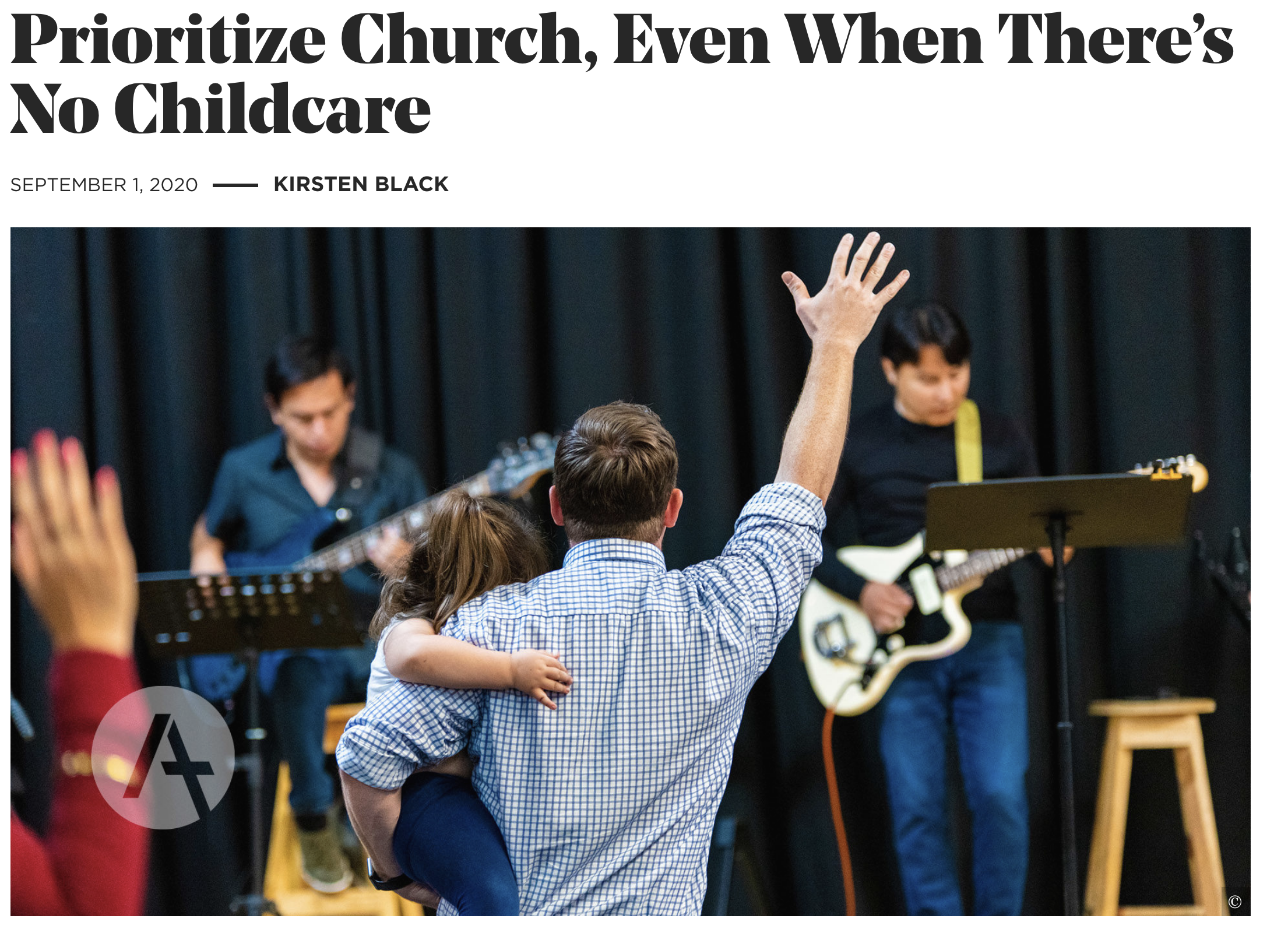
As churches return to worship following the coronavirus pandemic, many churches which once offered alternative activities for children during the service are no longer able to do so. But as a recent Gospel Coalition article by a mother of five boys argues, that may be no bad thing.

Screenshot 2020-09-02 at 23.44.14.png

The presence of small children in the worship service is one of the things which Robert Godfrey highlights in his book: An Unexpected Journey: Discovering Reformed Christianity.

Having previously posted a list of resources on children in church, below is a section of an article on Children in the Church by Joel Beeke (along with a couple of videos on related topics):

‘Children should attend public worship with their parents to experience the corporate life of the body of Christ. They should learn how to worship by watching others worship. Don’t discourage mothers from bringing young children into worship (Luke 18:15–16). The prophet Joel included “the children, and those that suck the breasts” in the call to sacred assembly (Joel 2:16). Encourage families to bring their children to worship. You might reserve a section in the back or in the balcony for families with very young children. If they need an early exit, this can be done without distracting or disturbing other worshippers.

The Scriptures teach us to view the assemblies of the church as gatherings of the household of faith. God’s children are called to be brothers to each other. When Moses commanded that the law be read publicly every seven years, he said, “Gather the people together, men, and women, and children, and thy stranger that is within thy gates, that they may hear, and that they may learn, and fear the Lord your God, and observe to do all the words of this law” (Deut. 31:12). When the Israelites celebrated the feasts of the Lord, the law required them to come to the sanctuary as “households,” including sons and daughters and even servants (Deut. 12:7, 12). (Cf. Josh. 8:35; 2 Chron. 20:13; Joel 2:16).

Children were also present in the synagogues where Christ taught (Matt. 18:2; 19:13–15). Paul assumed that children would be present when his letters were read in the churches, and he even addressed the children directly (Eph. 6:1–3; Col. 3:20). Jeremy Walker writes, “The constant presumption of Scripture is the children were present in the worship of the people of God.” Don’t separate children, teenagers, and adults into different worship compartments; bring them together as members of one family, and encourage them to sit together as families so that parents can make good use of the situation to train their children in godliness.

Including the children will influence how ministers of the Word prepare for public worship. When you offer public prayer in the worship service, include the children. Pray specifically for children and young people. Intercede for God to grant them Spirit-worked submission to their parents, regeneration, faith, repentance, and spiritual growth. If a child is sick, pray for him by name. Encourage them to sing by making frequent use of songs the children already know and love—and encourage parents, in teaching the children at home, to give priority to the songs used in the worship of the church.

In preaching, labor to speak with plainness and simplicity, but also with color and vitality, in the way of a good storyteller, to interest even your youngest hearers in the sermon. If it is necessary to speak “over their heads,” stop and address the children directly, giving them explanations or applications at the level of their own understanding. Nothing is more off-putting than to have a preacher tag a statement with “boys and girls,” and then, go on to say things that no boy or girl could understand or care about. Likewise, with regard to the length of the service, think of the children, and take care not to prolong sermons or prayers to the point that they cease to edify and only become a trial to be endured.’

Where the Reformed Church in Scotland falls short

In our morning services, we’re currently working our way through Christ’s letters to the seven churches in Revelation. One of the classic commentaries on Revelation was written by the Scottish Covenanter James Durham and first published shortly after his death at the age of 36.

Of all the seven letters, Durham said that the letter to the church in Ephesus (Revelation 2:1-7) was the one that was most relevant to the Covenanted Church in Scotland, and called on his readers to ‘look upon this epistle as if Christ were writing a letter to Scotland’.

He says that Christ’s problem with the Reformed Church in Scotland in his day wouldn’t have been because of their lack of orthodoxy or zeal or outward worship - but a lack of love for God manifested in a lack of love for one another:

‘Wonder not why God quarrels with Scotland; we need not say it is for corruption in doctrine or discipline, nor for our zealous going about it; that was not his quarrel with Ephesus…Neither is it his quarrel with us, but as it was his quarrel with Ephesus, that she was fallen from her first love, so it is with us.

…Our Lord Jesus would never have quarrelled [with] Ephesus nor us for zeal and faithfulness. But…there is a declining love, especially love to God and love to one another, which may be seen in our walking uncharitably and untenderly. A defection in the manner of performing duties; our fasts have not been from a right principle, our censures not in love to the souls of the people; much roughness and untenderness in drawing them forth.

…Therefore look upon this epistle as if Christ were writing a letter to Scotland; and in his letter saying, “for as much purity and zeal as you have, yet you are fallen from your first love; much of your love, warmness and tenderness is away”’.

Screenshot 2020-09-02 at 23.07.44.png

He says elsewhere that the church in Ephesus was zealous for the external worship of God, but had failed to live out the ‘one anothers’:

‘Though there was zeal in the external Worship of God: yet there was great defect of that love, sympathy and affection of one of them, with and to another, that should be; this being ordinary, that love inflamed toward God, and love one to another, go together: and therefore as it importeth they had fallen from their former warm impressions of love to God, so also from their kindly affection one to another, and had fallen in part to be more in sacrifice, and externals of Worship, than in Mercy and love one to another’.

Durham comments later on that it was likely that the outward state of their church was admired because of purity of their outward worship and the vigour of their discipline, as it is ‘too ordinary for men to think too much of external forms’.

He concludes: ‘Nothing has more influence in procuring judgement than coldness in love to God and others’.

Dignity but no life!

Last Lord’s Day evening, Stephen preached on 2 Samuel 6:12-23 under the theme ‘Dignity but no life’. For a sermon on the same passage which particularly applies it to the church in Scotland today, as well as the history of the RPCS in the twentieth century, we highly recommend this sermon preached in the Airdrie congregation by Carla’s father, Rev. Andrew Quigley, in 2011:

You can listen to the audio of the above sermon here.

For some more background on the transformation that the Airdrie congregation saw - and that by God’s grace we are working to see in Stranraer - see this article: Can a church turn around?