It seems that the break between football seasons gets shorter every year. It won't be long before a (somewhat-changed) Stranraer FC side take to the field at Stair Park against Irish League Champions Larne on 20th June. A week later, NIFL Championship side Dundela will be the visitors — I wonder whether I'm the only Stranraer fan to have watched Dundela play home and away. Certainly, if we're now playing friendlies against NIFL Championship sides, I've got to hope that one year we'll play my hometown team Institute (who finished 31 points better off than "The Duns" last time around)!
The close season also provides a well-deserved break for Stranraer's excellent media team, who are the envy of many other clubs. As well as the very professional match highlights, the revamped podcast ("Look Blues Talking") has been a great addition. And in this month's column, I can't resist revisiting a comment that was made as Laurence and Brian — described on the BBC last year as "the best people involved in club commentary in Scotland" — commentated on Stranraer's final match of the season.
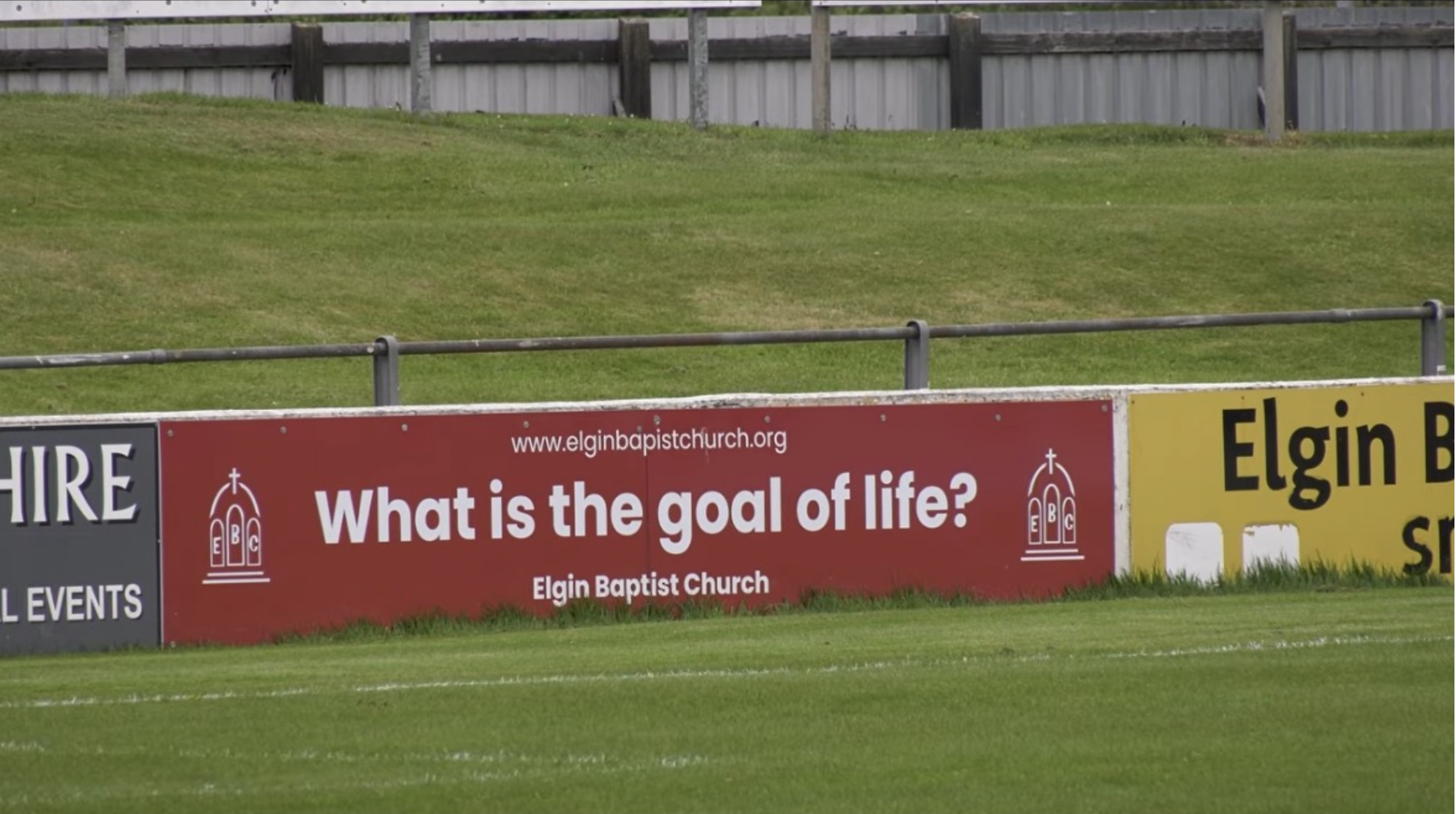
What piqued their interest was an advertising board at Elgin's Borough Briggs stadium, which simply reads: "What is the goal of life?"
And so at a break in play, Laurence put that question to Brian, and said he'd come back to him for the answer on the following week's podcast.
As it was, listeners got not one but two answers. Brian's was: "Just be nice...try and be nice to everybody...try and be a good person". Stranraer fan Martin McClelland wrote in to say that, according to Epicurus, the goal of life was to achieve simple happiness through the absence of pain.
It's a great question to ask. Indeed, if we ever change our church's advertising board at Stair Park — which currently reads "Because Life is More than a Game" — we might just borrow that one from Elgin Baptist Church.
One thing I love both about the question — and about the two answers that were given — is the assumption that life has a purpose. I find it interesting that many people who believe that life is the result of random chance, will still talk about meaning and purpose. Because surely if we live in a purposeless universe — as so many say they believe — then there's no place for talking about life's purpose. Yes, as individuals we might still come up with goals and aspirations, but surely there could be no overarching purpose which we could call everyone to aim for.
I find the inconsistency interesting. For all our talk about living in a purposeless universe, for all our confident assertions that we are no different from animals, we so naturally talk about purpose — and use the categories of right and wrong — that it's almost as if we believe there was a Creator. For all our modern, Western, secular disbelief in God, it's almost like we believe we live in a universe that throbs with purpose, and where categories like right and wrong really do exist and aren't simply human constructs.
Why do we grieve over wasted lives? Surely it's because, deep down, we believe that everyone has a purpose.
One of the great things about being a Christian, therefore, is that I don't need to try and come up with a sense of purpose. Rather, I was born with a purpose that was given to me by a wise and kind and good Creator. And whenever seasons of life change — for example, when the kids grow up and move out —I don't need to try and find a new purpose.
My problem isn't trying to find a purpose — my problem so often is living for the wrong things. It’s seeking joy and happiness in the wrong places. As the wise preacher puts it in Ecclesiastes, after years of close observation of human beings, "God made man upright, but they have sought out many schemes".
Indeed, we often fear to even ask what our purpose is. Jeremy Vine said recently that one of the things that makes us human is "our inability to stop the world and ask the biggest question of all, for fear that the result will be the end of our beautiful dance".
We don't ask the big question about purpose, Vine says, because we fear the answer. And in a sense we're right to fear, if we stop with the first part of the answer. The Bible tells us that we are more sinful than we ever dared believe. Brian's right — we should aim to be good people. But none of us live up to God's standards: "None is righteous, no, not one" (Romans 3:10). BUT, if we face up to the bad news, the good news is that through Jesus we can be more loved and accepted than we ever dared hope.
And we can be set free to live, not for a purpose we've had to invent for ourselves, but for a purpose prepared for us by a loving God from before the creation of the world.
Published in the Stranraer & Wigtownshire Free Press, 2nd June 2026