Looking for a Leader to Save Us

Last month, The Times had a fascinating article entitled ‘It’s too much to hope the King can save us from ourselves’. The author, A. N. Wilson, said that with the country in economic, political and social turmoil, there was a real sense that the British public were looking to Charles III to turn things around. Commentators have been talking about the King ‘hitting the ground running’ – a phrase more suited to a politician than a monarch. And yet for Wilson, the very strength of constitutional monarchy, as exemplified in Queen Elizabeth II, is to remain above politics. And so although there are tough times ahead, ‘we lay an unnecessary burden on our new King if we pretend that he, or any monarch, is able to solve them’.

But if a constitutional monarch can’t save us, what about a politician? Tuesday marked the inauguration of the third Prime Minister in the lifetime of our seven-week old son. Many people are hoping that Mr Sunak will be able to turn things around. The markets certainly have more confidence in him than they did in his predecessor. But if Wilson is right that the UK is ‘impoverished, dangerously divided and viscerally confused’, then its surely beyond the abilities of any one man to change that.

And yet we keep hoping that someone will. Those who don’t want Sunak as PM still want a Prime Minister – they just think Starmer, or someone else would do a better job. Others conclude ‘they’re all as bad as each other’ – and yet we all have this tendency to pin our hopes on one particular individual. Whether that’s football fans hoping that a new manager will be the one to transform the fortunes of their club, or social media devotees following every move of a celebrity or influencer. There can’t be many of us who haven’t hoped that meeting someone special would change our lives.

Whether we look to celebrities, politicians or romantic relationships, we want someone we can follow, someone we can look up to, someone who will solve our problems. All of us look for someone to hope in. And tragically many live lives of despair, because those they hoped in let them down.

Looking for a human being to save us is nothing new. A commentary on the Biblical book of 1 Samuel, written by the Australian pastor John Woodhouse, is entitled ‘Looking for a Leader’. The book of 1 Samuel recounts the desire of the nation of Israel to have a king ‘that we may be like all the other nations, and that our king may go out before us and fight our battles’ (1 Samuel 8:20). For their first king they choose a man called Saul. He looked the part, but was a dismal failure as a king. Halfway through the book, David, ‘a man after God’s own heart’, was anointed as king in his place. David was Israel’s greatest ever king, and yet he also committed adultery and murder. Still, David remained the standard by which future kings were judged. Throughout the rest of the Old Testament, there is a desire for a king ‘like David’ (2 Kings 14:3).

After centuries of despair, those hopes were finally fulfilled in Jesus Christ, who – as the angel Gabriel told Mary – would be given ‘the throne of his father David’ (Luke 1:32).

Finally, a king had come who really could transform our lives. He is a king who really can ‘save us from ourselves’. From a Christian perspective, the fundamental problem with our society is not the economy, but our rebellion against our Creator. Politicians disappoint us, and yet they reflect our values as a nation. Few would disagree with the statement that ‘Britain is broken’. But why is it broken? As one MP put it last week, after thirty years when there has been a ‘total disregard for the things that give us meaning’ – including the family – ‘we are now reaping the whirlwind: chronic public and private debt, chronic family breakdown and chronic despair’.

And yet the attack on the foundations of society continues. Last week, Keir Starmer called for a more extensive ban on ‘conversion therapy’, which would outlaw aspects of ordinary Christian pastoral care. On Monday, a Conservative MP announced that the UK Government would commission abortion services in Northern Ireland, against the will of the people, and in the face of the resistance of NI’s own health department.  

Despite the current whirlwind we are reaping, we simply press the self-destruct button even harder. We need a King who can save us from ourselves.

The Queen's Funeral: Her gift to us

No doubt many of us were part of the estimated 4 billion people around the world to watch at least part of the Queen’s funeral. Staggeringly, that’s double what the world population was when the Queen was born – and half of it today.

What I found particularly remarkable about it all is that through the readings, psalms, hymns and addresses, the largest TV audience in history got to hear the Christian message of resurrection life in the face of death.

I’m under no allusion that the vast majority of those there on the day – including some taking part – actually believed what they were hearing, singing and reading. But I think we can be fairly confident that the Queen did. And to the extent that she tailored the songs and readings to highlight the hope she had, her funeral was her last – and possibly greatest – gift to us. 

So what was the message of the funeral?

The closing verse of the first hymn pointed beyond the Queen and her Empire, to a greater Monarch, and a greater Empire. Speaking of God, it declared: ‘Thy throne shall never like earth’s proud empires, pass away’. One day all earthly empires will come to an end – but not the kingdom of Jesus Christ.

One of the most moving parts of the services was the removal of the crown, orb and sceptre from the coffin. Elizabeth II had worn that crown with great dignity for seven decades. Eventually, however, she took it off for a final time. Not so with her Saviour: ‘Your kingdom is an everlasting kingdom, and your dominion endures throughout all generations’ (Psalm 145:13)

For many, the thought of giving up whatever small amount of worldly glory or status we may have is a thing to be resisted. Whatever we think of as our ‘crown’, we hold onto for as long as we can. The message the Queen wanted to leave us with at her funeral however was that she gave her crown up willingly. Another hymn spoke of the day when ‘we cast our crowns before thee, lost in wonder, love and praise’.

One of the most counter-cultural messages to come out of the Queen’s funeral was that death is not just a natural part of life. Deep down, we know that already of course. When we stand before the coffin of a loved one, everything inside us cries out ‘it wasn’t meant to be this way!’ The first reading at the funeral described death as an ‘enemy’. However the reading also looked forward to the day when that ‘last enemy’ would be destroyed.

Christianity teaches that death was no part of God’s original creation. But men and women tried to overthrow God’s good and loving reign – and as a result, suffering and death came into the world. But Christianity also teaches that on the cross, Jesus defeated death for his people. That just as the grave was not able to hold him, it will not be able to hold us either.

For me, the most powerful moment of the whole funeral was at the very beginning. Westminster Abbey dropped to a hush and, with all eyes on the coffin, the choir proclaimed Jesus’ breathtaking claim: ‘I am the resurrection and the life. Whoever believes in me, though he die, yet shall he live’.

Hearing that claim is one thing – believing it is another. Yet when it came to Her Majesty, we have reason to believe that she did both. And because of that faith in Jesus, the final words of Psalm 23 (also sung at the funeral) were true for her – as they can be for us: ‘in God’s house for evermore my dwelling place shall be’.

To sum it up, the message of the most watched television broadcast of all time, was that there is a far greater Monarch than Elizabeth II or Charles III. Our late Queen had been reminded of that at her coronation, with the words: ‘Receive this orb set under the cross, and remember that the whole world is subject to the Power and Empire of Christ our Redeemer’.

The sad truth is that every one of us tries to set up our own empire rather than submit to his. And yet the greatest of all Kings laid aside his privileges to come into this world and reconcile us to God through his death.

As the Archbishop of Canterbury said in his sermon: ‘Christ rose from the dead and offers life to all, abundant life now and life with God in eternity’.

Published in the Stranraer & Wigtownshire Free Press, 29th September 2022

Textual Confidence

Has God’s word been deliberately tampered with over the years? Have verses teaching the deity of Christ been systematically removed from our Bibles? Are the differences between ancient, modern and Reformation-era Bibles so significant that some of us have completely different Bibles from our fellow church members? Does admitting uncertainty about any part of the Biblical text (as the KJV translators did in their footnotes), mean that we can’t be certain about any of it?

You can read the rest of this article by Stephen at the Gentle Reformation blog

Why are Christians such hypocrites?

As human beings, we hate hypocrisy. Whether it’s public figures taking private jets to climate change conferences or politicians telling people to host a refugee while refusing to do so themselves.

But while we don’t like hypocrisy in general, religious hypocrisy gets us even more. We’re indignant when people who claim to live according to a higher standard – and perhaps even tell others they should do the same – don’t even live up to those standards themselves.

In 1999 the actions of a minister in this town made national headlines for that very reason. A member of his congregation was quoted in the Daily Record as saying: ‘He was always preaching about the sin of adultery…I have never known such hypocrisy’.

I’ve no doubt there are many who have never been back at church since, for that very reason. And while for some the claim that ‘Christians are just a bunch of hypocrites’ may simply be an excuse, for others it’s a genuine stumbling block when it comes to accepting the claims of Christianity.

It’s an objection which can’t simply be explained away by saying that genuine Christians aren’t hypocrites. If hypocrisy is defined as saying one thing and doing the opposite, all Christians are hypocrites to some extent – and I include myself in that.

Now it is true that all who claim to be Christians wouldn’t be recognised as such by Christ himself. He tells us: ‘Not everyone who says to me, “Lord, Lord”, will enter the kingdom of Heaven’. Church attendance in Scotland has fallen drastically, but even now only a fraction of those who go to church would define themselves as ‘evangelical’ or ‘born again’ Christians. And if most churchgoers would say ‘we can’t take the Bible literally’ – then it’s no surprise that they don’t live their lives according to it.

But what about those who have genuinely committed their lives for Christ and are seeking to live for him? We are hypocrites too in that we fall short of the standards we say we try to live by. But that would only be a deal-breaker if our hope for heaven was in trying to be better than those around us.

The following quote might sound shocking, even to many churchgoers, but I think it’s an accurate summary of the Christian gospel: ‘To be a Christian is to acknowledge your utter moral failure and to throw yourself on the mercy of the only truly good man who ever lived’. The Bible isn’t ultimately the story of good people and bad people. Some of the most famous Bible characters fell short of God’s standards in huge ways. Yet their hope wasn’t in their own goodness, but in the fact that the one truly good man who ever lived – Jesus Christ – lived and died in their place.

But if someone does throw themselves on Jesus’ mercy, does that mean it doesn’t matter how they live? Not at all! Before we are converted, God’s law simply condemns us; after we’re converted, it becomes a guide for living. And yet although we now genuinely want to do what God says, we often fail. The Christian life is an ongoing battle in which, as Jesus’ brother James put it, ‘We all stumble in many ways’.

If we define hypocrisy as not living up to how we think everyone should live, every true Christian is guilty as charged. But hypocrisy can also be defined as wearing a mask and pretending to be better than you really are. And what I think you will find if you spend time among genuine Christians, is that the element of pretence is largely gone. You’ll find people who are genuinely trying to live for Jesus, whether other people are watching or not.

So we’re right to be angry about religious hypocrites – in fact, Jesus saved his strongest words for them. Yet if we think we’ll be ok on Judgement Day because we’re going to tell God about all the religious hypocrites we knew, his response might simply be ‘I know – but what about you?’

However we define our terms, all Christians are hypocrites to some extent. But the Christian’s great goal in life is to point away from themselves to the one person whose life always backed up his lips – Jesus Christ. He came to earth not merely to be an example that we could never live up to, but to die in place of hypocrites like us, so that his record of flawless obedience could be counted as ours.

Published in the Stranraer & Wigtownshire Free Press, 25th August 2022

Global RP Unity: Camps, Conferences and more

Over the past year or so, the RP Global Alliance have contributed a series on Global Unity to the various RP Church magazines around the world - the Covenanter Witness, RP Witness and Good News. Stephen was asked to contribute two articles from a historical perspective. You can read the second one below:

Having considered in the previous article how Reformed Presbyterians have sought to express unity with believers outside the RP church family, we are now going to consider how a sense of unity has been fostered between the various denominations which make up the global RP Church.

International Support and Encouragement between Covenanters

There were, of course, personal links between Covenanters in Scotland, Ireland and North America even before the formation of the various Reformed Presbyterian denominations. Congregations in what are now the United States and Canada were formed as Covenanters emigrated from the Old World to the New, with pastors sent from Scotland and Ireland to minister to them. The first American RP Presbytery was formed in 1774 by four immigrant Irish and Scottish RP ministers. In 1858, the first RP congregation in Australia was started after an Irish RP licentiate was sent as a Colonial Missionary.

While the majority of Covenanter ministers who crossed the Atlantic in the eighteenth century did so permanently, there were also who visited for the sake of mutual encouragement, before returning home. In 1789 Rev. James Reid was given leave from his duties in South West Scotland to visit America, returning the following year with a call from South Carolina, either to himself or to any other member of the Presbytery – which they all declined. This practice of ‘mutual eligibility’ – a minister in one RP denomination being free to receive a call from a congregation in another RP denomination – has continued without controversy to the present day.

As time went on, traversing the Atlantic became less of an ordeal. In fact, in 1844, Rev. John Sprott (a Scottish RP licentiate who had become a Seceder minister in Nova Scotia), commented that ‘crossing the Atlantic is now an easy matter’ as it only took ten days. In 1860 RPCS minister John Graham, having recently become minister in Liverpool, went to America and came back with $3000 which enabled his new congregation to finish their church building. Irish RP minister Thomas Houston spent four months in the States in 1856, and an American obituary stated ‘his friends and admirers on this side of the Atlantic were as numerous as those in the country of his birth’. William Milroy was the first RPCS minister to train for the ministry in North America, studying at the university of Toronto, before being licensed by the RP Presbytery of Pittsburgh in 1861 and immediately returning home to accept a call in Scotland.

 International Conferences

Opportunities for unity between the various RP denominations, particularly in the form of conferences, began in 1896, and really took off in the second half of the twentieth century. Obvious reasons for this were the rise of air travel – journeys which had once been measured in weeks and then days, now only took hours – as well as better economic conditions in the English-speaking world.

Another reason is that by the time of the first international conference in 1896, it was clear that institutional unity with other denominations would be impossible for RPs unless they gave up their distinctive principles. The second half of the 1800s was a time when there was a great push for the different denominations to unite with each other. As we saw last time, these efforts at visible unity were something that Reformed Presbyterians had a great deal of sympathy for, and some of the leading RPs of the 19th century were noted for their catholicity and warm personal friendships with those in other denominations. However, they were not in favour of unity at any cost.

In Scotland, the majority of the denomination, which had split off in 1863, united with the Free Church in 1876, which in turn merged with the United Presbyterian Church in 1900 and then the Church of Scotland in 1929. In 1872, RPCS minister Torrens Boyd, speaking at the Irish RP Synod, had prophetically warned that such unions were like chaining two ships together – when the waves begin to roll ‘they will rasp each other’s sides off, tear open each other’s hearts and go down together’. At the same Synod, the RPCI received a proposal from the mainstream (and still exclusively psalm-singing) Presbyterian Church in Ireland to discuss a potential union. They replied, acknowledging the Christian kindness and love of union in initiating the proposal, declaring their ‘earnest concern and desire to have the divisions of the Church speedily healed, on the grounds of Scriptural truth and duty’, but concluding that given their ministerial and membership vows, any discussions were unlikely to produce the desired union.

Against this background, the ‘First International Convention of Reformed Presbyterian Churches’ was held in Scotland in 1896. The purpose of was ‘to examine the distinctive doctrines that were held by the three Churches and to renew their commitment to these common principles’. The book published to commemorate the conference lauded its success in this regard: ‘The first international Convention in her history has infused new life into the Church, and cheered her ranks’. Another benefit of the conference was that ‘Covenanters from the Old and New Worlds met each other for the first time face to face, and clasped hands warmly together in a friendship which will endure while life lasts’.

One of the resolutions at the conference was to ask the Synods to hold a similar convention in 1899. As it turned out, however, it was almost four decades before a similar conference was held – marking the tercentenary of the signing of the National Covenant of Scotland in 1938. The conference – once again held in Scotland – was organised by Revs A. C. Gregg, W. J. Moffett (RPCS) and Rev. J. Boyd Tweed (an American pastor who had recently been inducted as pastor in the Glasgow RP Church). The number of delegates totalled 630, with more joining them for the various public meetings.

Once again, it was hoped that a series of conferences would follow, but the war and its aftermath delayed plans. International Youth Conventions were held in Scotland in 1962 (with 35 Americans chartering a plane) and Ireland in 1964.

The first all-age International Conference of the modern era was held in 1966 in Carlton College, Michigan. Between 60 and 70 Irish RPs chartered a flight to attend, with a total attendance of 1352. A conference planned for Scotland in 1968 did not take place. Further International Conferences in the US were held in 1966 and 1970, with the planned 1974 conference moved to 1976 due to fuel shortages. Since then, International Conferences have been held in America every four years, with the venue changing to Calvin College, Michigan in 1996 and then Indiana Wesleyan University in 2012. The conference planned for 2020 was initially postponed for a year due to the outbreak of COVID-19, before being cancelled altogether. God willing, we will return to IWU in 2024.

 International Conferences organised by the Irish RP Church have been held every four years from 1982, initially at Kerrykeel, then Portrush, Termonfeckin (five times), Gartmore (Scotland – twice) and from 2018 at the Gold Coast in Waterford.

 The current arrangement means that an International Conference is held every two years, alternatively in the USA and the UK/Ireland. As the years have gone by, the number of countries represented has increased dramatically given new RP works in Asia and South America.

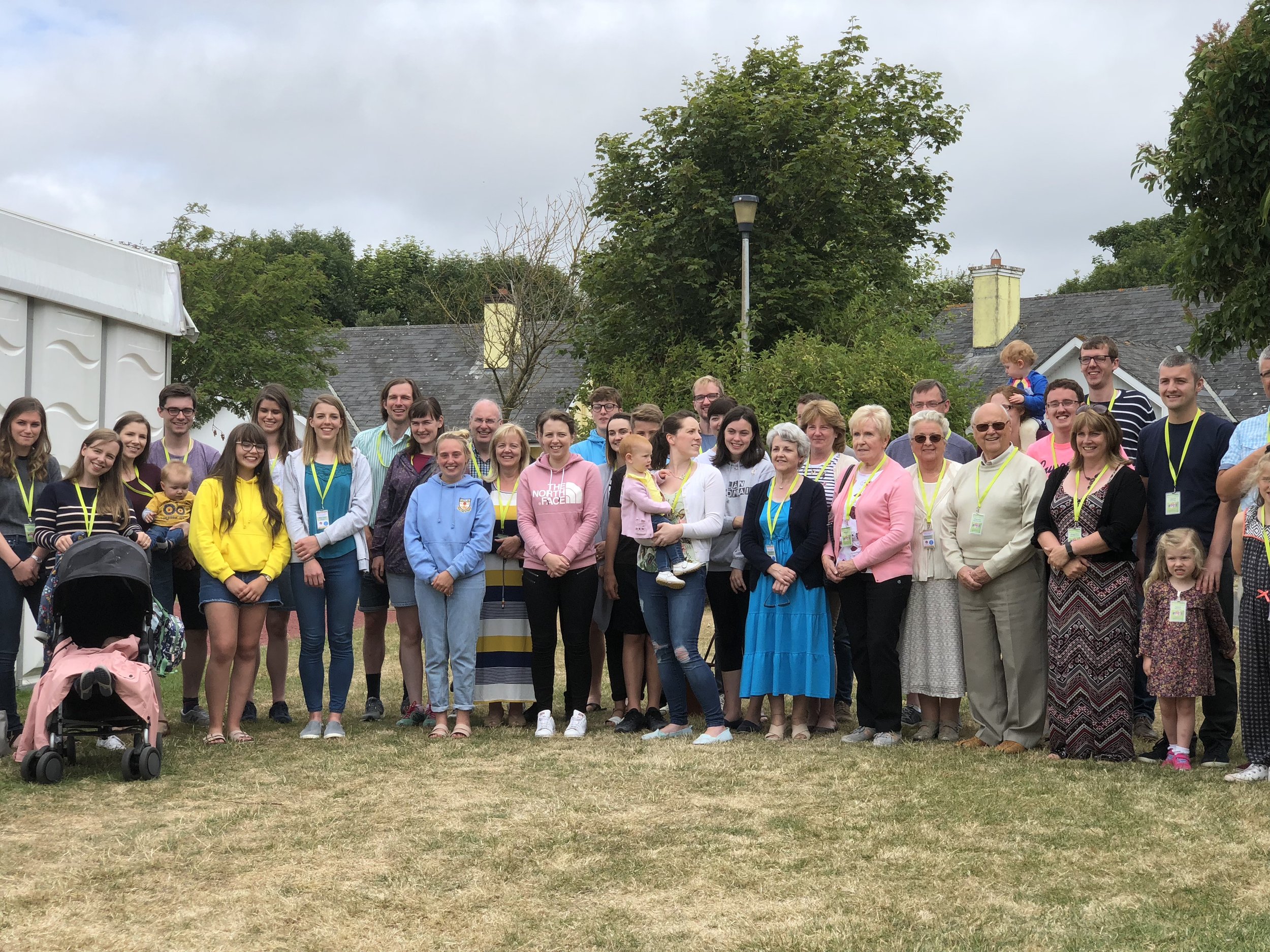
The RPCS contingent at the last International Conference in Waterford in 2018

 Opportunities for Global Service and Ministry

The Geelong Bible Conference is held in Australia every two years and has featured speakers from the RPCNA, RPCI and RPCS, as well as from those outside the global RP church. Due to their relative proximity, the Australian RP Church has taken a particular interest in the Japanese Presbytery, sending and receiving mission teams, as well as sending ministers to teach at Kobe Theological Hall (as other RP denominations have also done). 

A ‘Consultative Committee of the Three Covenanting Churches’ met 3 times during the 1966 conference and discussed efforts by the Synods towards drawing the three churches together. They discussed the following issues: Praise (namely the possibility of an international psalter), Christian Education, Magazines, Exchange of Personnel (in the form of pulpit exchanges and stated supplies, as well as Irish RPs teaching and studying at RPTS as well as Belfast), Foreign Mission Work, International Conferences, Pensions, and Reciprocity in Doctrine.

A joint meeting of ministers and elders representing the Churches in Scotland, Ireland and America was due to be held in July 1972 in Portrush but was cancelled due to the outbreak of the ‘The Troubles’ in Northern Ireland. In our own day, the RP Global Alliance seeks to continue these efforts to facilitate cooperation between the various denominations.

Since 1997, congregations in the various RP denominations have benefited from hosting RP Mission Teams, organised by the RPCNA, but with opportunities for others to serve as well. Irish and Scottish young (and older) people have served together on go teams.  Young people from the US and elsewhere have had the opportunity to experience the wider RP church through formal initiatives like the Covenanter Summer Institute and Semester in Scotland, as well as through attending church camps in Ireland. Irish young people have taken part in Theological Foundations Backpacking trips in Colorado. Seminary students have taken advantage of the opportunity to do internships in RP congregations on other continents.

Many of us have been personally enriched by these connections, and while we feel the smallness of our own denominations at times, those things we perhaps miss out on are more than compensated for by being part of a global body with an international vision and an abundance of opportunities for service and fellowship together.