
Include the Children (Joel Beeke)

As churches return to worship following the coronavirus pandemic, many churches which once offered alternative activities for children during the service are no longer able to do so. But as a recent Gospel Coalition article by a mother of five boys argues, that may be no bad thing.
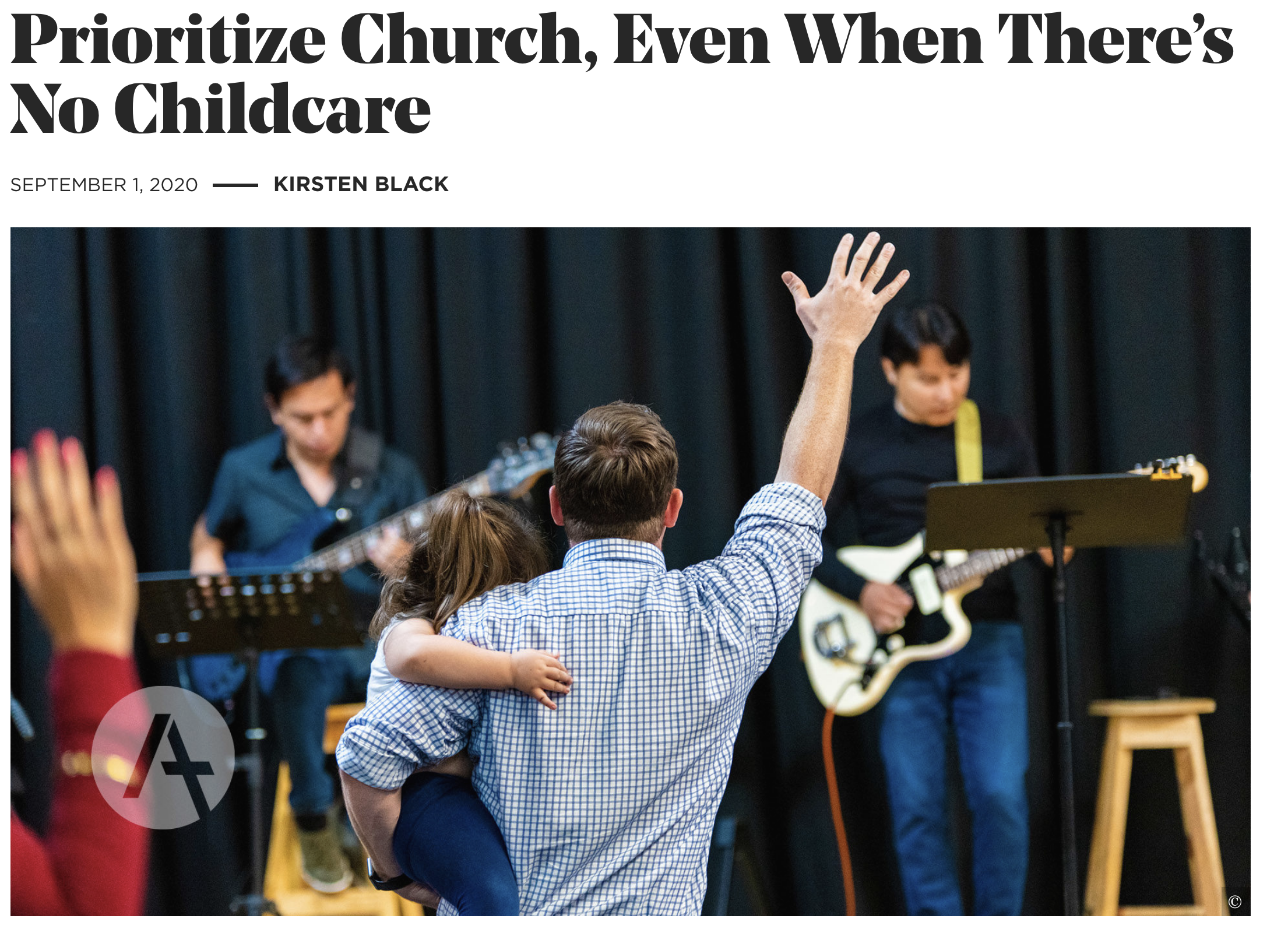
Screenshot 2020-09-02 at 23.44.14.png

The presence of small children in the worship service is one of the things which Robert Godfrey highlights in his book: An Unexpected Journey: Discovering Reformed Christianity.

Having previously posted a list of resources on children in church, below is a section of an article on Children in the Church by Joel Beeke (along with a couple of videos on related topics):

‘Children should attend public worship with their parents to experience the corporate life of the body of Christ. They should learn how to worship by watching others worship. Don’t discourage mothers from bringing young children into worship (Luke 18:15–16). The prophet Joel included “the children, and those that suck the breasts” in the call to sacred assembly (Joel 2:16). Encourage families to bring their children to worship. You might reserve a section in the back or in the balcony for families with very young children. If they need an early exit, this can be done without distracting or disturbing other worshippers.

The Scriptures teach us to view the assemblies of the church as gatherings of the household of faith. God’s children are called to be brothers to each other. When Moses commanded that the law be read publicly every seven years, he said, “Gather the people together, men, and women, and children, and thy stranger that is within thy gates, that they may hear, and that they may learn, and fear the Lord your God, and observe to do all the words of this law” (Deut. 31:12). When the Israelites celebrated the feasts of the Lord, the law required them to come to the sanctuary as “households,” including sons and daughters and even servants (Deut. 12:7, 12). (Cf. Josh. 8:35; 2 Chron. 20:13; Joel 2:16).

Children were also present in the synagogues where Christ taught (Matt. 18:2; 19:13–15). Paul assumed that children would be present when his letters were read in the churches, and he even addressed the children directly (Eph. 6:1–3; Col. 3:20). Jeremy Walker writes, “The constant presumption of Scripture is the children were present in the worship of the people of God.” Don’t separate children, teenagers, and adults into different worship compartments; bring them together as members of one family, and encourage them to sit together as families so that parents can make good use of the situation to train their children in godliness.

Including the children will influence how ministers of the Word prepare for public worship. When you offer public prayer in the worship service, include the children. Pray specifically for children and young people. Intercede for God to grant them Spirit-worked submission to their parents, regeneration, faith, repentance, and spiritual growth. If a child is sick, pray for him by name. Encourage them to sing by making frequent use of songs the children already know and love—and encourage parents, in teaching the children at home, to give priority to the songs used in the worship of the church.

In preaching, labor to speak with plainness and simplicity, but also with color and vitality, in the way of a good storyteller, to interest even your youngest hearers in the sermon. If it is necessary to speak “over their heads,” stop and address the children directly, giving them explanations or applications at the level of their own understanding. Nothing is more off-putting than to have a preacher tag a statement with “boys and girls,” and then, go on to say things that no boy or girl could understand or care about. Likewise, with regard to the length of the service, think of the children, and take care not to prolong sermons or prayers to the point that they cease to edify and only become a trial to be endured.’

Protestant or Catholic - what's the difference?

We’ve probably all been asked ‘What’s the difference between Protestants and Catholics?’ A 3-minute video obviously can only scratch the surface of that question, but this is a helpful summary of the key difference when it comes to how someone becomes right with God:

The clip is taken from the 2019 film American Gospel, the first hour of which is available to watch free on youtube. The whole film is currently available on Netflix.

Update: Here’s another video answering the same question:

Where the Reformed Church in Scotland falls short

In our morning services, we’re currently working our way through Christ’s letters to the seven churches in Revelation. One of the classic commentaries on Revelation was written by the Scottish Covenanter James Durham and first published shortly after his death at the age of 36.

Of all the seven letters, Durham said that the letter to the church in Ephesus (Revelation 2:1-7) was the one that was most relevant to the Covenanted Church in Scotland, and called on his readers to ‘look upon this epistle as if Christ were writing a letter to Scotland’.

He says that Christ’s problem with the Reformed Church in Scotland in his day wouldn’t have been because of their lack of orthodoxy or zeal or outward worship - but a lack of love for God manifested in a lack of love for one another:

‘Wonder not why God quarrels with Scotland; we need not say it is for corruption in doctrine or discipline, nor for our zealous going about it; that was not his quarrel with Ephesus…Neither is it his quarrel with us, but as it was his quarrel with Ephesus, that she was fallen from her first love, so it is with us.

…Our Lord Jesus would never have quarrelled [with] Ephesus nor us for zeal and faithfulness. But…there is a declining love, especially love to God and love to one another, which may be seen in our walking uncharitably and untenderly. A defection in the manner of performing duties; our fasts have not been from a right principle, our censures not in love to the souls of the people; much roughness and untenderness in drawing them forth.

…Therefore look upon this epistle as if Christ were writing a letter to Scotland; and in his letter saying, “for as much purity and zeal as you have, yet you are fallen from your first love; much of your love, warmness and tenderness is away”’.

Screenshot 2020-09-02 at 23.07.44.png

He says elsewhere that the church in Ephesus was zealous for the external worship of God, but had failed to live out the ‘one anothers’:

‘Though there was zeal in the external Worship of God: yet there was great defect of that love, sympathy and affection of one of them, with and to another, that should be; this being ordinary, that love inflamed toward God, and love one to another, go together: and therefore as it importeth they had fallen from their former warm impressions of love to God, so also from their kindly affection one to another, and had fallen in part to be more in sacrifice, and externals of Worship, than in Mercy and love one to another’.

Durham comments later on that it was likely that the outward state of their church was admired because of purity of their outward worship and the vigour of their discipline, as it is ‘too ordinary for men to think too much of external forms’.

He concludes: ‘Nothing has more influence in procuring judgement than coldness in love to God and others’.

Sir Andrew Agnew - Remember the Sabbath Day

34468203673_cb9d88ba9f_k.jpg

Around four miles from Stranraer is a 60-foot tower with the inscription ‘Remember the Sabbath Day to keep it holy’.

The monument, towering above Leswalt, was erected in 1850 in honour of Sir Andrew Agnew, seventh baronet of Lochnaw, and friend of former Stranraer minister William Symington. Agnew was elected as MP for Wigtownshire and used his position to bring a bill before Parliament prohibiting all labour on the Lord’s Day, except for works of necessity and mercy. On his fourth attempt, the bill reached the committee stage, before the death of King William IV caused a dissolution of parliament. Agnew’s efforts brought him a bitter personal attack from Charles Dickens.

IMG_4107.jpeg

The Agnew Monument, on the site of an Iron Age Hill Fort (Tor of Craigoch), contains a number of (badly-weathered) inscriptions. The inscription on the south side reads:

"Erected by a few of the Inhabitants of this district and other friends in memory of the late Sir Andrew Agnew of Lochnaw Bart [Baronet]. As a token of the esteem so universally & deservedly entertained for him & the respect in which the memory of his name & character, his life & labours is cherished. 1850.”

Above is the Agnew shield with its motto Consilio non Impetu, and above a curved inscription, “Remember the Sabbath day to keep it holy”.

A book-length commemoration of his life (Memoirs of Sir Andrew Agnew) was written the year after his death by Original Secession (and later Free Church) minister Thomas M’Crie. A briefer Memoir of Sir Andrew Agnew was published shortly after his death by James Bridges.

IMG_4112.jpeg

The entry for him by David Hempton in the Dictionary of Scottish Church History and Theology reads as follows:

“Agnew, Sir Andrew (Lochnaw) (1793-1849), politician and sabbatarian.

The posthumous son of Andrew Agnew, he succeeded to a baronetcy in 1809, attended Edinburgh University and married Magdalene Carnegie in 1816. He entered parliament in 1830 as a member for Wigtownshire, which seat he successfully defended twice, in 1831 and 1832, before failing in his candidature for the Wigtown boroughs in 1837. In politics he was a moderate reformer, but his parliamentary career was dominated by an unremitting campaign for sabbath observance. As the chief parliamentary spokesman for the Lord’s Day Observance Society he introduced four bills designed to prohibit all unnecessary labour on Sunday, the last of which reached the committee stage before Parliament was dissolved on the death of William IV. Although unsuccessful, all four bills occasioned considerable controversy both inside and outside the House of Commons. His opponents, including Charles Dickens, alleged that his measures were exclusively directed against ‘the amusements and recreations of the poor’. In response Sir Andrew stated that he was equally opposed to the casual amusements of the rich and that the poor would be the ultimate beneficiaries of a labour-free Sunday.

Although denied a parliamentary platform after 1837, Sir Andrew continued to promote the sabbatarian cause, particularly in the Scottish railroad industry, where he used his substantial financial influence to win important concessions. Renowned for his perseverance and consistency of purpose, he did as much as anyone to lay the foundations of the so-called Victorian Sunday.”

You can listen to two sermons about the Lord’s Day, taken from our series on the Ten Commandments, below:

Let's Talk About Drugs

Update: Sadly we have had to postpone this meeting, but we plan to rearrange it at some point in 2021

On Friday 18th September we will be holding a public meeting at which Trevor Wills will tell his story of drug addiction and the hope and new life that enabled him to break free.

On Sunday our minister Stephen will give two follow-up addresses under the theme ‘A Tale of Two Sons’.

The leaflets below will be given by our GO Team who will be here from 12th-19th September:

Screenshot 2020-08-18 at 15.53.15.png
Screenshot 2020-08-18 at 15.54.50.png