RPCS Day Out in Ayr

Last month, we in Stranraer organised an event for the whole denomination in Ayr. The following report is taken from the RPCS website:

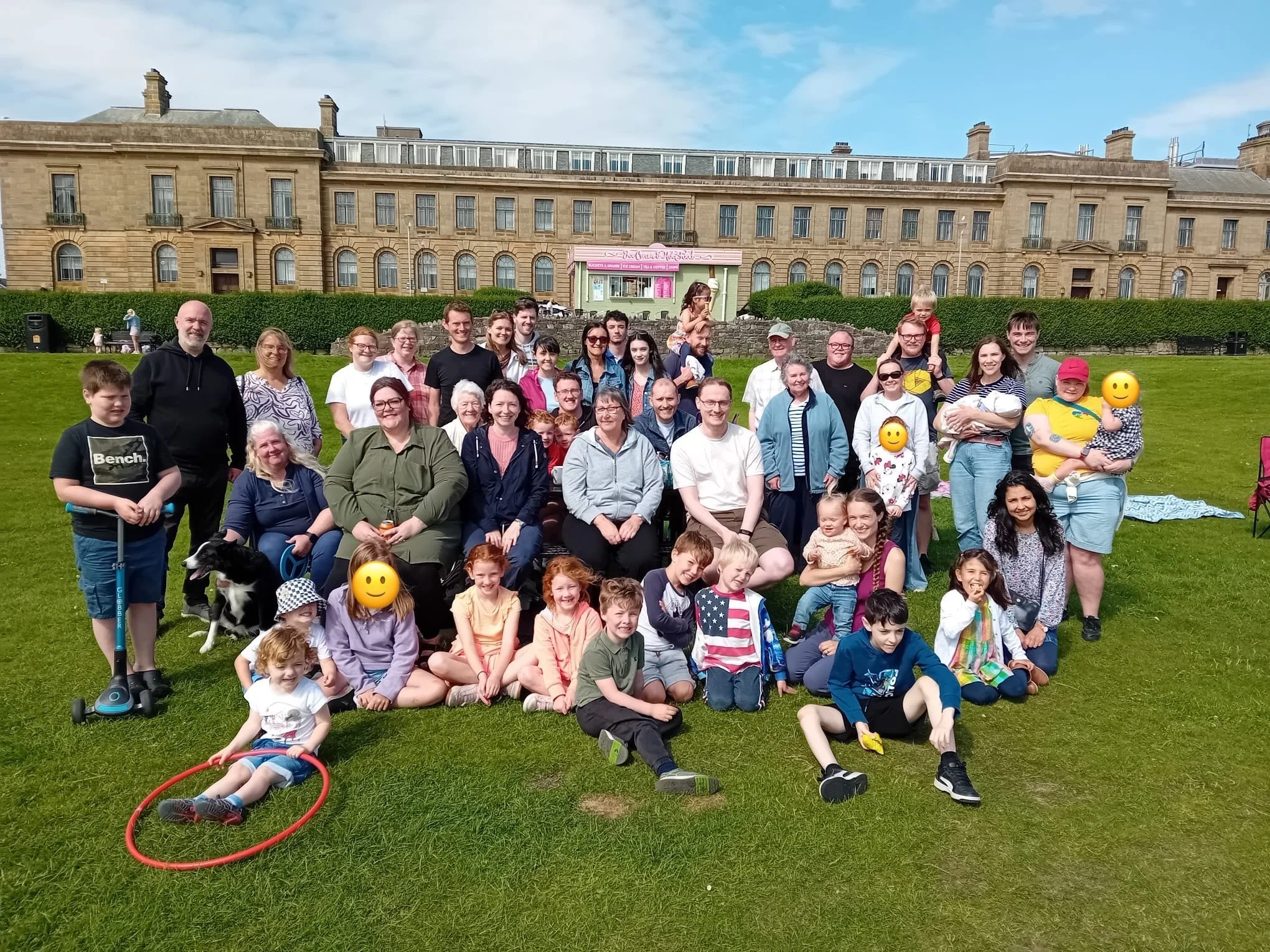
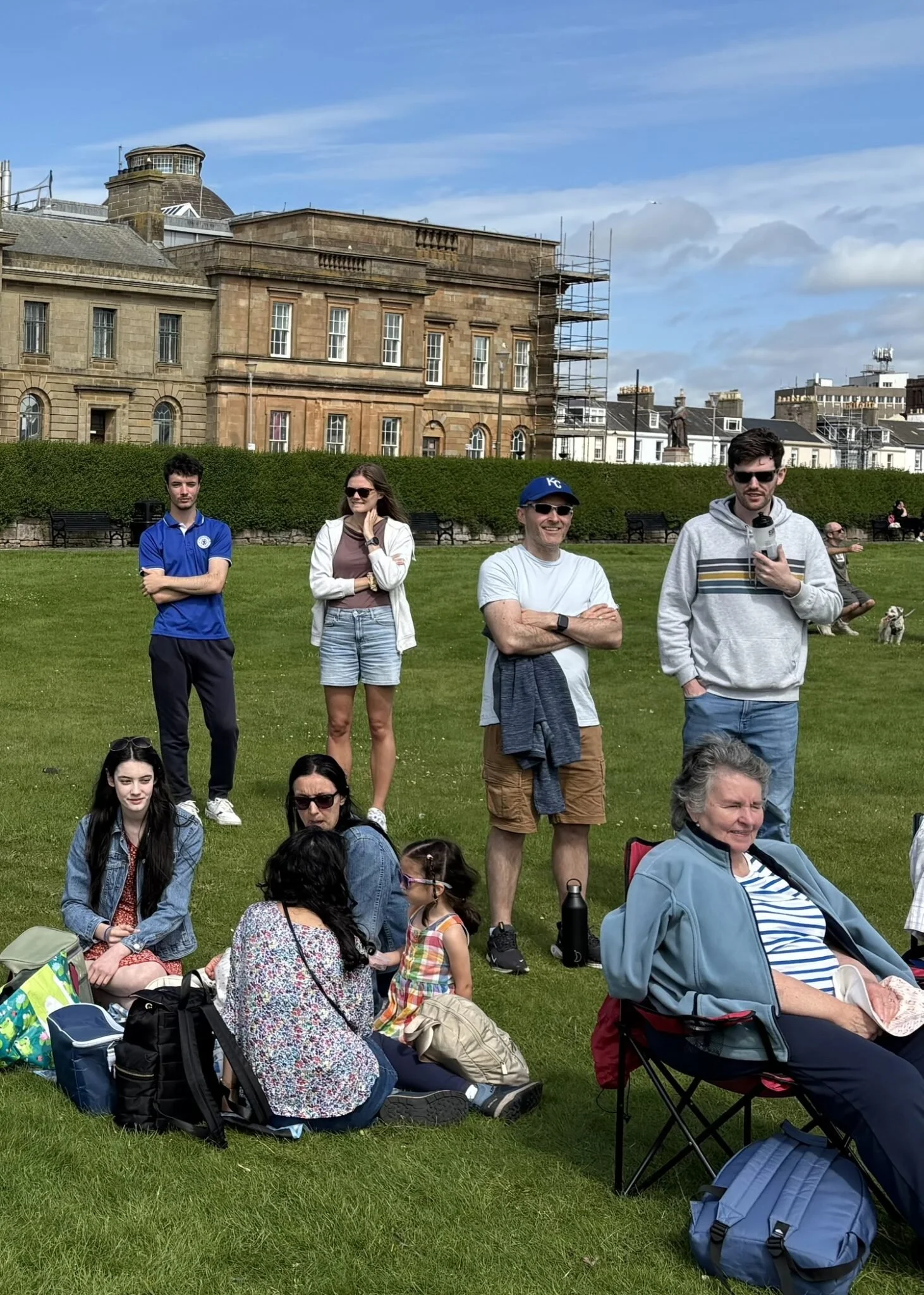
Each year a different church in the Presbytery organises a Presbytery-wide event. This year it was Stranraer’s turn and they planned a lovely day in Ayr on the 2nd August. 55 people from Airdrie, Glasgow, North Edinburgh, Stranraer, and Wishaw attended, and we were blessed with beautiful weather.

The day began with everyone meeting for a picnic lunch on the Ayr Lower Green. After some time chatting and catching up over our sandwiches, it was time for a walk to the old cemetery in Ayr, where Jimmy Fisher (from Airdrie RPC and Tour Guide for our Presbytery ministry, Reformation Tours) gave a talk at the grave of 7 Covenanter martyrs who were all hanged at Ayr. They had been captured at Rullion Green in November 1666, and were part of a group of twelve men brought from Edinburgh to Ayr to stand trial for their part in the Pentland Rising. After the inevitable outcome, all were sentenced to death. Part of the inscription on their grave reads (like so many of the martyr graves in Scotland) that they died “For their adherence to the Word of GOD and Scotland’s Covenanted work of Reformation”. We then sang Psalm 23 and Psalm 133 and James Fraser prayed.

We then walked back to the green where there were all sorts of games and races for young and old alike involving parachutes and hula hoops. Folks continued to chat and spend time getting to know new people from the different congregations and catching up with old friends. It was a lovely day and many thanks to Stranraer RPC for organising it.

'This is not a fulfilling life': Why success can’t satisfy

American golfer Scottie Scheffler made headlines at the Open Championship in Portrush last month - and not just for winning it. On the eve of the tournament, he gave an interview that made people around the world sit up and take notice. In a day when sports stars undergo media training and their answers to questions are routine and formulaic, Scheffler tore up the script by asking what the point of it all was.

Many would envy Scheffler - 14th on Forbes' list of the 2025 'World's Highest Paid Athletes', jetting around the world to play sport. Yet when interviewed, Scheffler said bluntly: 'This is not a fulfilling life'. He went on to elaborate: 'It’s fulfilling from the sense of accomplishment but it’s not fulfilling from a sense of the deepest places of your heart. There are a lot of people that make it to what they thought was going to fulfil them in life, and you get there, you get to number one in the world, and they’re like “what’s the point?”

Scheffler knows all about the relentless nature of chasing success only to be left feeling empty when you achieve it: 'It feels like you work your whole life to celebrate winning a tournament for like a few minutes. It only lasts a few minutes, that kind of euphoric feeling.'

His words may have been deeply personal, but the newly-minted Open champion has put his finger on something countless human beings experience every day. We all have aspirations. We all have dreams. Some people make incredible sacrifices in order to make their dreams a reality, whether those dreams involve athletic accomplishment, career progression, or family goals. Yet often the most crushing experience isn’t to miss out on those dreams; it is to finally make them a reality and discover that they cannot satisfy us in the way that we were so sure that they would.

On winning the tournament, Scheffler elaborated on his earlier comments: 'I love being able to play this game for a living — it’s one of the greatest joys of my life. But does it fill the deepest wants and desires of my heart? Absolutely not.' In fact, he sounded a warning to those watching: 'This is not the place to look for your satisfaction'.

Scheffler, however, as found a greater purpose. 'I would say my greatest priorities are my faith and my family', he said. 'Those come first for me. Golf is third in that order'.

In fact, his faith in Jesus is what frees Scheffler to enjoy golf but keep it in proper perspective. Last year, after his second Masters win, Scheffler gave another revealing interview. He said that on the final morning of his tournament, his friends reminded him that 'my victory was secure on the cross. And that’s a pretty special feeling. To know that I'm secure for forever and it doesn't matter. You know whether or not I win this tournament or if I lose this tournament, my identity is secure for forever.'

In other words, what defines Scheffler isn't sporting success, but what Jesus did for him on the cross. So he doesn't have to win championships to prove his worth. ‘Do I want to win every single golf tournament? Of course. But at the end of the day, that’s not what’s gonna satisfy my soul.'

After his 2022 Masters win, Scheffler put it succinctly: 'The reason why I play golf is I’m trying to glorify God and all that he’s done in my life. So for me, my identity isn’t a golf score'.

If we look for created things - including other people - to give us our identity, we'll be disappointed. That's true even of good things. Many would say their family were their number 1 priority. But no human being can bear the weight of all our hopes and dreams. Either it will crush them, or they will disappoint us. Scheffler instead encourages us to look to the Creator. Only when we obey the first of the Ten Commandments - and put God at number 1 - will we be able to keep everything else in proper perspective.

Still in his 20s, Scheffler has made it to the top. He sees it as a platform God has given him to warn the watching world that success can't satisfy. Don't wait until you achieve your deepest earthly longing to realise it can only disappoint. You were made for more.

Published in the Stranraer & Wigtownshire Free Press, 7th August 2025

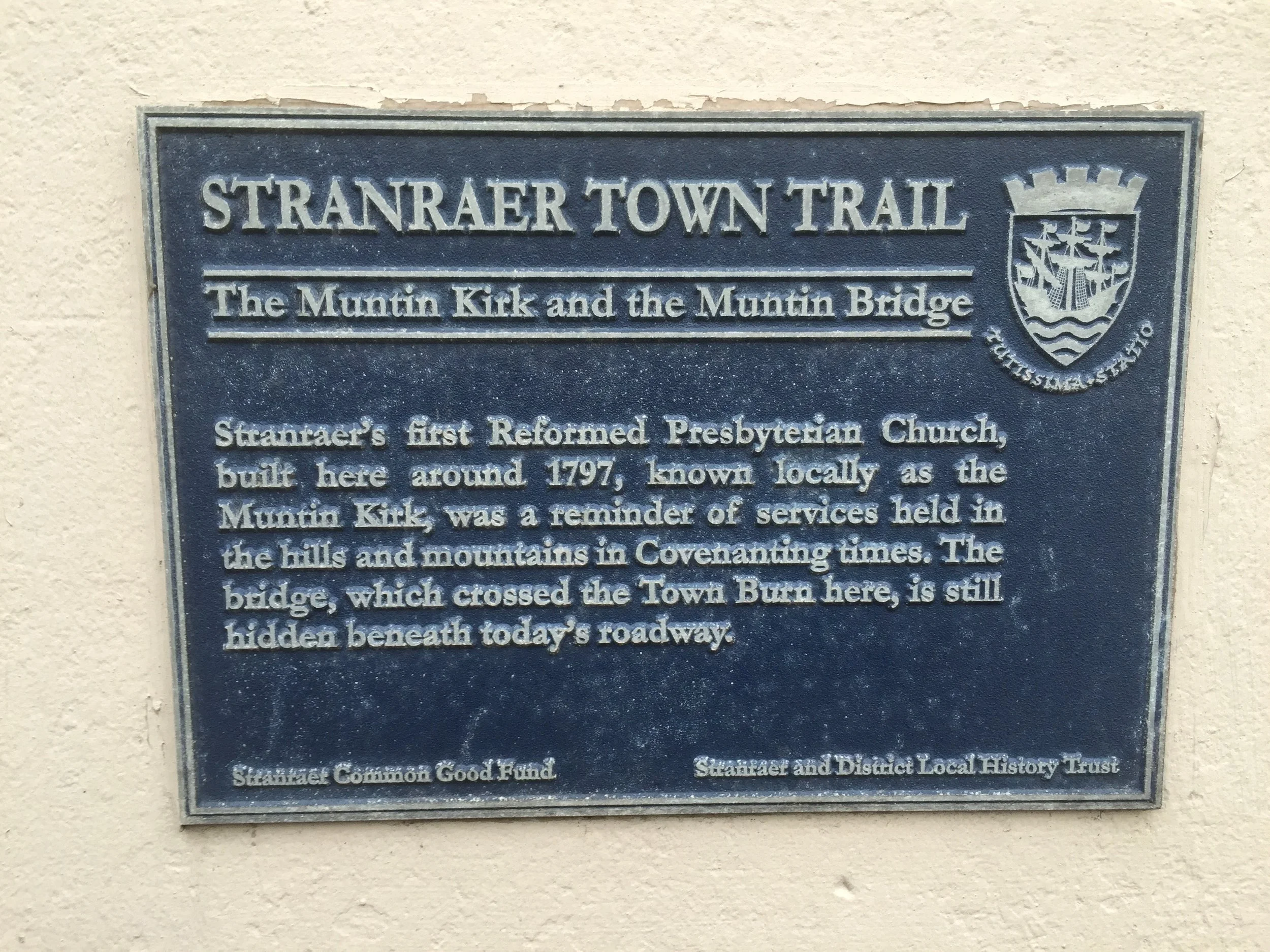
Stranraer Town Trail - The Muntin Kirk

Our church building features on the Stranraer Town Trail, which highlights 19 places of interest in Stranraer. The blue plaque, on the front well of the building, notes that when the original RP church building in Stranraer was built around 1797, it was known locally as the Muntin (Mountain) Kirk as a reminder of services held in the hills and mountains in Covenanting times.

An accompanying leaflet, produced by the Stranraer & District Local History Trust, says:

“The R. P. Church was built in 1825. Once known locally as the Muntin’ Kirk, it is a reminder of the days when members met in secret in the hills to avoid religious persecution. Beneath the modern road are the old ‘Mountain Bridge’ and another culverted stretch of the town burn.”

The first place of interest on the leaflet is the Castle of St John: “In 1678 it was used as a base by John Graham of Claverhouse — Bluidy Clavers — and his troops during their pursuit and suppression of local Covenanters”.

Other places of interest included are North Strand Street, Burnfoot, North West Castle, the Garden of Friendship, the Stranraer Distillery, McCullouch’s Mill, Tradeston, Little Ireland, New Town Hall, McWilliam’s Pump, Dunbae House, the Old Parish Church, the Old Town Hall, the Princess Victoria monument, the West Pier, George Street, and Jubilee Fountain.

The following history of Stranraer is included on the leaflet:

“The place-name Stranraer is thought to mean the row of houses on the strand or shore. Alternatively the name could be a combination of the Gaelic words struathan and reamhar and means the fat stream' or the 'place where the shoals of fish are to be found'.

The town of Stranraer came into being late in the Middle Ages. Around 1510 the Adairs, a powerful local family, built a massive stone castle which was both a family home and an administrative centre for their estates. Stranraer grew up in the shadow of the castle. It became a Burgh of the Barony in 1595 and in 1617 was elevated to a Royal Burgh by James Vl.

By the late 18th century Stranraer was the largest town in Wigtownshire. Its economy was based on tanning, fishing, boat building and linen weaving and it acted as the market centre for the western part of the county. Potatoes and grain were exported to Ireland and huge quantities of timber were imported from the Baltic and later Canada.

In the early 19th century Stranraer was a moderately prosperous place but further development was hampered by the town's geographical isolation. That was to change in 1861 when the railway came to town. The following year work was completed on the new East Pier and in 1872 the iron paddle-steamer 'Princess Louise' inaugurated the ferry service to Larne. Stranraer now had good rail contacts with Glasgow, central Scotland and the north of England and, more importantly, had become the principal ferry port between Scotland and Ireland.”

The Skiffies and the Storm

The SkiffieWorlds are one of Stranraer’s success stories. An article in the Scotsman on Saturday described the coastal rowing championships as ‘the celebration of community in a town that refused to become a backwater’. It reflects ‘the ambition of a community refusing to accept decline as inevitable’ – and indeed is ‘one of Scotland’s most remarkable community regeneration stories’. Last time round, between 20,000 and 30,000 visitors descended on the town – bringing in an estimated £3.5 to £4 million for the local economy. This time is the biggest ever with a record-breaking 79 teams taking part.

You don’t have to look too far in the Bible to find stories about boats: from Jonah being thrown overboard, to Jesus and his (mostly) fishermen disciples on the Sea of Galilee, to the three shipwrecks of the Apostle Paul. In fact, at eight miles across, the Sea of Galilee, that Jesus and the disciples frequently crossed, is the same width as Loch Ryan is long.

One story involving Jesus, the disciples and the water, took place when Jesus told them to cross those eight miles of the Sea of Galilee to the other side. Partway across however, a great windstorm arose, and the waves were breaking into the boat, which began to fill with water.

We can tell how bad a storm it was from how the disciples react. Many of them were experienced fishermen. They knew this stretch of water like the back of their hands. They had seen in all. But when this storms hits, they’re absolutely terrified.

And yet despite all this, Jesus was in the stern of the boat, asleep on a cushion – the only time in the gospels we read about him sleeping. But the disciples wake him and say ‘Teacher, don’t you care that we’re perishing?’ And then we read the remarkable words: ‘And he awoke and rebuked the wind and said to the sea, “Peace! Be still!” And the wind ceased, and there was a great calm’.

It’s not that the storm merely started to subside when he spoke. In a split second it became as still as glass. And how do the disciples react? Well they were ‘afraid’ before. But now they were ‘filled with great fear’.

Why? Let’s put ourselves in their shoes. These were men who had been brought up living and breathing the Old Testament. It was in their veins. And they knew that what Jesus had just done is something taken right out of Psalm 107. Calming a storm like this was something the Bible described only God as doing.

Psalm 107 talks about men who’re at their wits’ end. They cry to the Lord in their trouble, and he delivers them from their distress. He makes the storm be still and the waves of the sea be silent. And that’s exactly what Jesus does here. Someone has said: ‘The elements knew the voice of their Master, and, like obedient servants, were quiet at once.’

At this point the disciples realise that an event which they’ve been singing about all their lives has just happened in front of their very eyes. Which can only mean that this man they’ve been travelling around with, eating with and talking to – is God himself. And so no wonder that ‘they were filled with great fear and said to one another “Who then is this, that even the wind and the sea obey him?”’

During the storm, the disciples were fearful in the sense of timid or cowardly. But a different word for fear is used to describe their response to Jesus calming it. It refers to an appropriate fear. Because if you think about it, sometimes fear is healthy. If you’re working with electricity there’s a healthy kind of fear which won’t leave you a shivering wreck, but it will mean there are certain things you won’t do. You realise the power that electricity has – and so you act accordingly. And in the same way if we truly realised the power that God has, we would act accordingly. But amazingly that doesn’t mean running from him – but to him. So often we fear the wrong things, like what other people will think of us. But don’t let the opinion of others keep you away.

The best illustration of all this comes from ‘The Lion, The Witch and the Wardrobe’. Four children arrive in a land of talking animals and find out that they’re going to be meeting Aslan, the great lion. When they find out he’s a lion they ask: ‘Is he quite safe?’ To which the response they get is: ‘Safe? Who said anything about safe? Course he isn’t safe. But he’s good. He’s the king, I tell you’.

Published in the Stranraer & Wigtownshire Free Press, 10th July 2025